
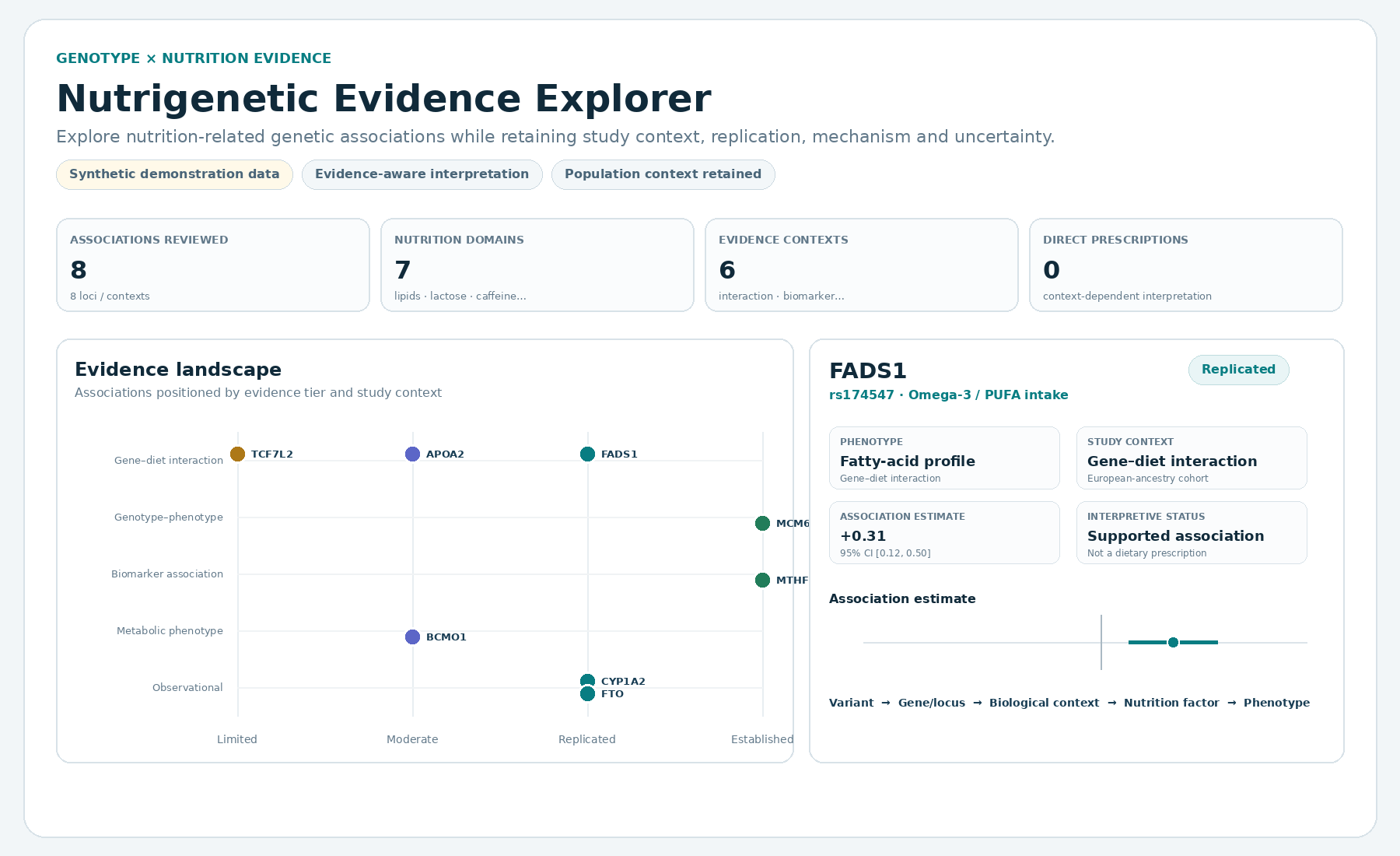
Nutrigenetic Evidence Explorer
Effects, confidence intervals, population, study design and evidence strength presented in a single review view.
Explore example →Analysis of genetic variants and genotype–diet interactions in research settings, with reporting that keeps estimated effects, uncertainty, population context and replication strength visible.
Nutrigenetics studies how genetic variation may be associated with differences in response to nutrients, foods or dietary patterns. It can include genotype–diet interaction analyses while keeping statistical association distinct from demonstrated causality.
It is distinct from nutrigenomics, which more broadly examines how diet can influence gene expression or gene regulation.
The scope depends on the scientific question, study design and available data. Analyses may include:
Gene–diet interactions can depend on the population studied, dietary exposure measurement, phenotype definition, statistical model and study power. Many published findings remain heterogeneous or insufficiently replicated to support an individualised dietary recommendation on their own.
UbSeq therefore uses a non-deterministic interpretation: a variant is not presented as a dietary instruction. Results are reported together with their methodological context and uncertainty.
Depending on the project: annotated and filterable tables, summaries of estimated effects and confidence intervals, population and study-design information, methods, quality-control elements and an interactive report for reviewing associations.
Effects, confidence intervals, population, study design and evidence strength presented in a single review view.
Explore example →